
The portal of metamorphosis
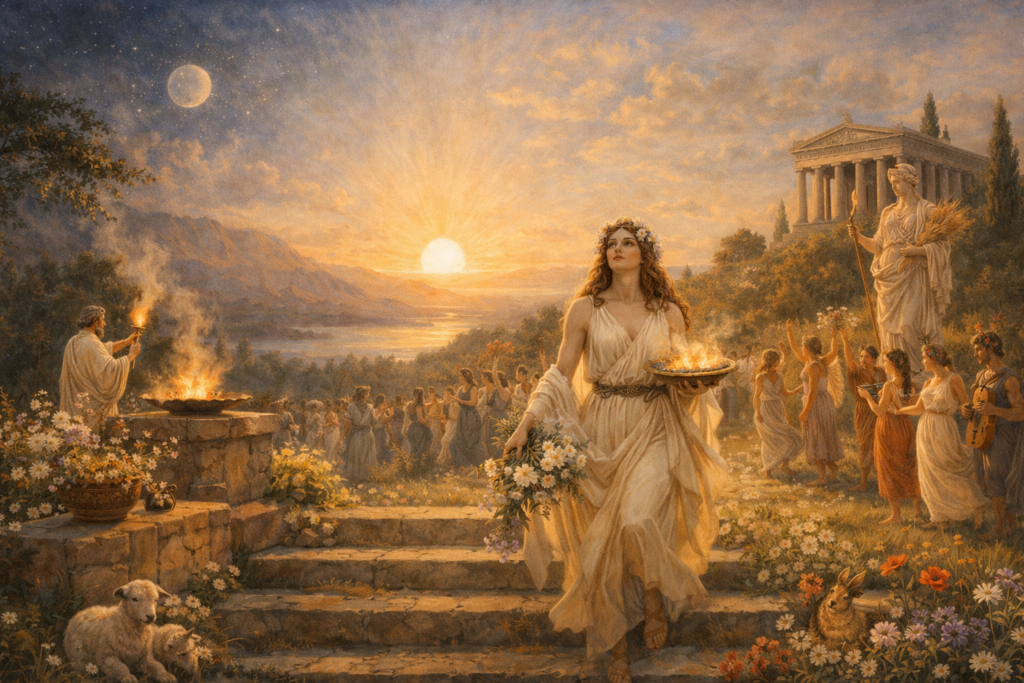
At this time of year, day and night come into balance. Light has not yet taken dominance, nor has the outward expression of spring fully begun. It is a threshold, an intermediate field where nature is not yet expressing itself with intensity, but quietly preparing.
If we observe closely, the Equinox does not show us the blooming; it reveals the conditions that make it possible. In the language of healing, this is the point at which the system, whether we speak of the body or the psyche, seeks regulation. It is not a moment for action, but for alignment.
Because no true change can be sustained without an inner equilibrium first being established.
In modern life, we tend to equate change with effort. We believe we must push, accelerate, and constantly “do” in order to evolve. Yet nature operates differently. First it balances, then it moves.
First it regulates, then it blossoms. The Spring Equinox invites us into this very space: to pause before the next movement. To observe what within us has completed its cycle, and what is ready to emerge. Not through urgency, but through awareness.
Within this context, the transition from winter to spring is not only external. It is an inner shift from contraction into expression, from silence into creation. And as in every healing process, this passage does not occur through force, but through presence.
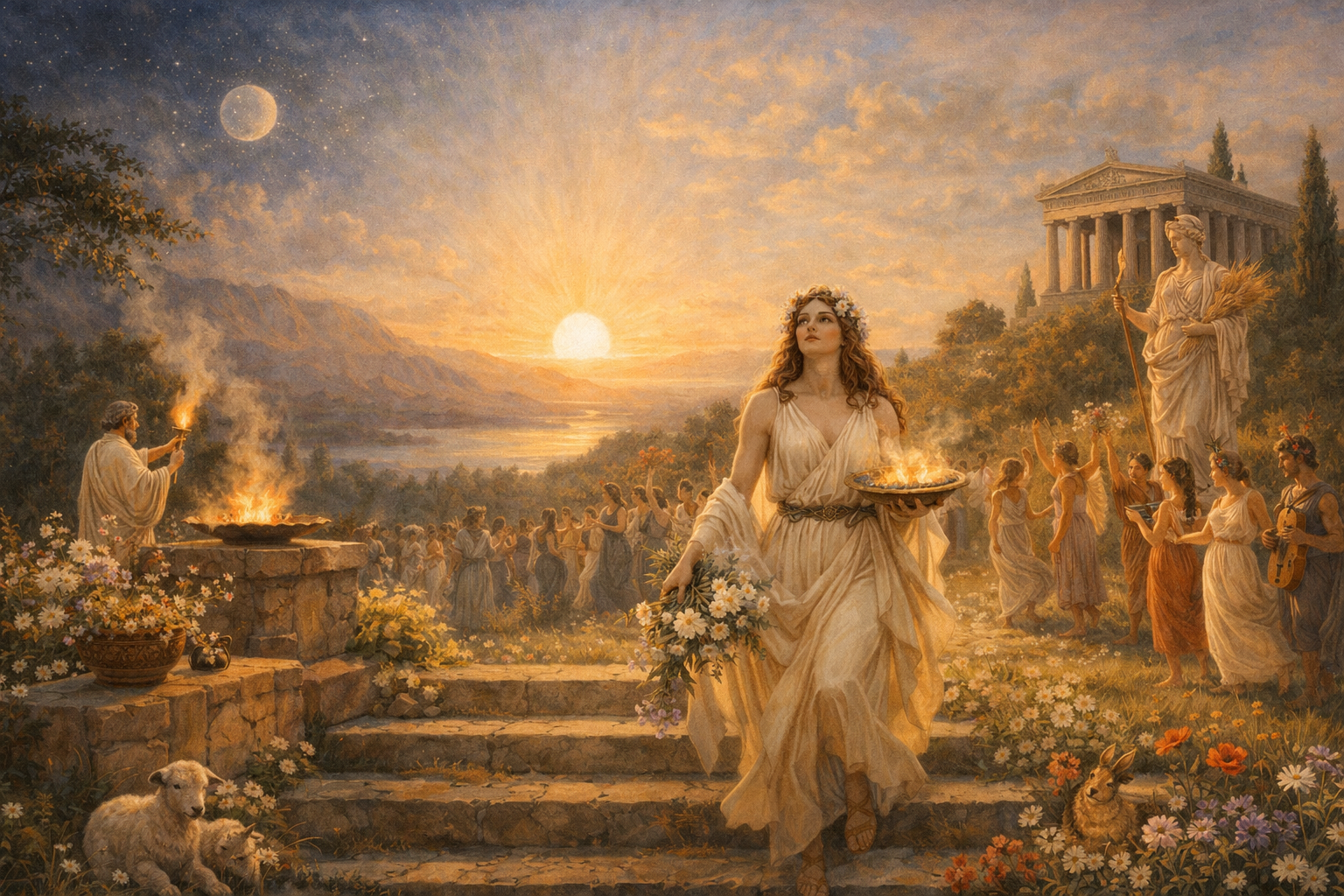
According to archeologists and philosophers , ancient civilisations did not perceive time as we do today, as a linear sequence of dates, but as a living, sacred cycle, intimately connected to the movements of nature and the sky. Within this worldview, the Spring Equinox was not merely an astronomical event. It was a threshold. A gateway of transition. A moment when the world moved from dormancy into renewal.
We have since antiquity descriptions of how the great spring festivals across the Mediterranean were deeply intertwined with myths of descent and return. Myths such as that of Persephone were not simply stories, but codes or ways of understanding life itself. The descent into the Underworld and the return to the light reflect a deeper law: that life does not move forward in a straight line, but in cycles, through phases of loss, silence, and re-emergence. The Equinox, then, was the moment when this cycle became visible not only in nature, but within the human experience.We can say with certainty that for the ancients, spring was not merely a season of blooming. It was an initiatory reminder:that every return to the light requires a passage through darkness.
And that renewal is not something that happens only around us, but something that unfolds within us, again and again, with every cycle . In this same context, scent held a profound role.In ancient cultures and especially in the Greek world fragrance was not merely a pleasant sensation. It was a form of reconnection. Olfaction is the most immediate of the senses. It does not pass through analysis; it enters directly into the nervous system, activating memories, emotions, and inner images before we are even able to name them. What modern neuroscience now confirms, the ancients understood through lived experience.
This is why scent occupied a central place in ritual life.It was not used simply to perfume a space, but to transform it. The ancient Greeks understood this deeply. They recognized that each deity responded to a specific aromatic that there was a particular scent capable of attracting divine attention and opening a channel of communication. For this reason, in their rituals, and even within the Orphic Hymns, we find specific incenses dedicated to the invocation of each God.
Are we, today, able to perceive these subtle nuances of scent as they once did? Not to the same extent. As the human species evolved, the sense of smell gradually lost part of its sensitivity.
Modern science suggests that humans today perceive fewer odors than they did thousands of years ago. Survival favored other senses, and olfaction was not developed to the same degree.
In initiatory traditions such as the Eleusinian Mysteries, the experience was not only visual or auditory it was deeply sensory. Scent actively participated in the process of initiation, guiding the participant from one state of consciousness into another. Because scent carries a unique quality: it does not only transport you to a place, but to an inner time.It brings you back. And here, once again, we encounter the deeper meaning of the Spring Equinox.The return of Persephone from the Underworld is not only a myth explaining the change of seasons. It is the re-emergence of memory.
Life itself “remembers” and returns to the light.In the same way, the scents of spring the first blossoms, the damp earth, the resins warming under the sun awaken something ancient within us.
A memory of life.
Perhaps this is why working with scent is not only a creative act. It is also an act of recollection. A return to something we already know, but have forgotten.Within this understanding, the Spring Equinox is not only an external shift in nature. It is an inner awakening of memory.
A moment in which, through the senses, we are invited to remember our place within the cycle of life. And perhaps this is why the Equinox holds such significance. Because it reminds us that balance is not a static state, but a living relationship between opposing forces and that it is through this relationship that life is born. If there is one question to carry through this time, it is not:“What should I do now?”
But… what within me needs to come into balance, so that what is ready to be born can truly blossom?
This is the deeper, therapeutic essence of the Equinox. Not the beginning of spring, but the inner readiness for it.
So this spring remember that its an invitation, not just a reminder. An invitation to return. To open to breath.
To awaken the senses.
To embody in this new cycle the new You!
Zoe Strantzali


